Posts

Not a lady afterall.
Image
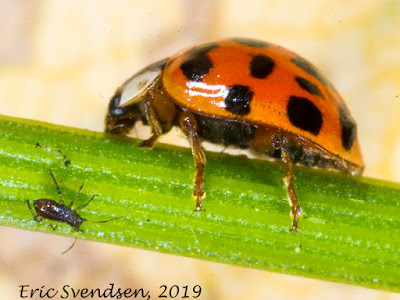
Thirteen spotted ladybird beetle hunting for aphids. Ladybugs are not bugs, nor are they ladies.  The ladybug, more appropriately called the ladybird beetle, is a friend to farmers and gardeners alike.  The ladybug got its name during the middle ages in Europe.  It turns out the farmers were having quite a tough time with an outbreak of aphids.  They must have been Catholic because they prayed to The Virgin Mary for help.  Not long after the crops recovered from the infestation, delivered by a host of ladybugs.  I guess they didn't care for the name marybug and the term ladybug stuck. The story above is one of many possible explanations of how the ladybug obtained its moniker (reference:  click here ).  Whether true or not, the title is ubiquitous and these beetles are found worldwide.  In Canada alone, there are 150 species.  Altogether there are about 5000 species.  Ladybirds, like all beetles, have complete metamorphosis....

The maze of life.

Image
The skeletonizing of a leaf by a leaf miner. Born to tunnel; a simple egg laid on a leaf produces a tiny caterpillar.  It immediately becomes an industrial machine, boring into the leaf and consuming the matter between layers.  Barely visible to the human eye, it proceeds in a relatively straight line until it finds an obstacle.  Undeterred, it changes direction and continues its momentum; becoming larger with each centimeter consumed.  The tunnels become larger and its progress faster.  Soon it has consumed almost half an entire leaf.  Thwarted by the main vein running through the middle, it is now large enough to chew through the tougher structure.  Continuing the destruction, the caterpillar finds an outside edge.  It is time to rest.  Spinning silken web, it makes a bed out of the very vegetation it has been consuming.  When it wakes, it will no longer be a caterpillar, but a newly emerged moth bent on laying its own eggs to star...

Willow sawfly larvae; not a caterpillar.

Image
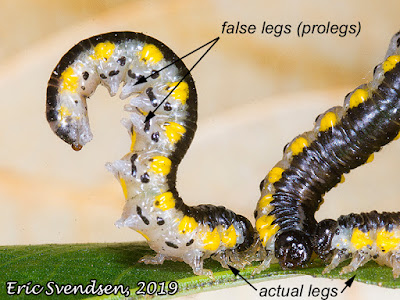
Willow sawfly larvae feeding on a willow leaf. Insects can be very hard to identify, and sometimes even getting the right group of insects can be challenging.  The above photo of a sawfly larva is a good example. Initially, one would probably mistake these caterpillar-like creatures as being either butterfly or moth larvae.  Both sawflies and lepidoptera (the group butterflies and moths belong to) have similar looking young.  The easiest way to tell if it is a caterpillar or sawfly is by paying attention to the prolegs. Prolegs are those peculiar suction cup type feet that exist at the back end of caterpillars.  We know all insects have 6 legs, so why do caterpillars seem to have so many more?  It turns out the first three pairs are the true legs.  The caterpillar's head is close to them.  The rest of the caterpillar has a series of false legs, called prolegs, which continue to the end of the individual.  The number of proleg pairs will he...

Cottonwood leaf beetles.

Image
A pair of cottonwood leaf beetles, on a cottonwood leaf. Cottonwood is a kind of tree which is usually found around fresh water.  It grows fast and the trees themselves can become very large.  They only live a short time (for a tree) though, around 80 years, and leave their remains as fodder for all kinds of creatures.  The trees are important because of the stabilizing properties they have for banks and beaches.  While alive, the trees are a favourite food of beavers (the bark) and the leaves are consumed by numerous mammal and insect species.  One of those is the cottonwood beetle. Cottonwood beetles reproduce rapidly and can spawn several generations in a season.  Although cottonwood is their primary food source, they will also take poplar, willow, and aspen.  In large numbers, these insects can defoliate a tree and are serious pests in management areas.  As summer ends adults will find their way under bark or leaf litter on the ground....

Ant milking aphids.

Image
Ant milking an aphid for honeydew liquid. The above photo represents one of the best images I captured this summer.  While camping near  Salmon Arm this summer I would spend part of my day wandering about with my macro gear.  I came across a busy ant colony and discovered that they were "milking" a herd of aphids.  Ants stroke their antennae across the back of an aphid and it responds by secreting a drop of sugary liquid from its abdomen.  The ant consumes the liquid and brings it back to the colony for dissemination.  This relationship between the aphid and the ant is a form of symbiosis called mutualism.  Both species benefit; the ant gets the sweet liquid and the aphid is protected.  Ants guard their aphids not so differently from the way a farmer guards a herd of cattle.  They protect them from predators such as ladybugs which will voraciously consume the little sugar factories if left unguarded.  One ant by itself may not be m...

Two-striped grasshopper.

Image
Two-striped grasshopper on common tansy. Have you ever found an insect and wondered what it was?  This is a query I am frequently burdened with.  I like to know the name of what it is I am looking at and to understand something of its life habits.  To facilitate this search for information I often refer to my insect guides. The problem with insects is that there is an unbelievable variety of them.  They are grouped into a total of 31 orders; each order is made of insects of a similar nature.  Butterflies and moths belong to the Lepidoptera.  Grasshoppers and crickets belong to the Orthoptera.  If you want to look at a complete list of insect orders, click here . The first chore is to figure out the order an insect belongs to.  This is important because it streamlines the search for the investigation.  There is no sense in looking for a beetle (Coleoptera) in a true bug (Hemiptera) category; it just won't be found.  Fortunately, i...

How to get rid of a wasp's nest.

Image
The yellow jacket wasp. Yesterday I was busily working on some yard work when I looked up and saw a most uncomfortable sight.  Wasps had moved in.  A small nook in my deck cover was now the home to a yellow jacket wasp colony.  If I have learned anything about wasps during my time on Mother Earth, it is that wasp nests only get bigger over time.  It is better to deal with them now rather than later.  It is one of those problems you simply cannot ignore and hope it goes away.  If you have ever played one of those computer games where you obtain resources and build an empire, the development of a wasp nest is something like that.  A single wasp, a queen, slowly constructs a tiny enclave in some hopefully safe spot.  Foraging for food, she builds a nest, lays her eggs, and tends the young until they mature.  These underlings then go on to forage, build, and tend in a slowly exponential manner.  Soon, small becomes big, then big beco...

Carrion beetle.

Image
A carrion beetle - Nicrophorus You have to admire beetles.  There are over a million species; they are so successful because of their design.  The larvae, called grubs, generally live burrowed into some substrate or remain hidden beneath overburden.  Some are surface dwellers and feed on vegetation.  The adults are really impressive though.  Their first pair of wings has been adapted into a hard chitinous pair of wing covers called elytra.  The whole body is well protected in the same material making them very durable given their size. Beetles inhabit a tremendous range of niches and display some of the most peculiar behaviours anywhere in the animal kingdom.  Many of them are also quite beautiful, although I fully admit that beauty truly lies in the eye of the beholder.  One of the prettiest beetles I have ever come across is the carrion beetle. Carrion beetles, both larvae and adults, feed on the flesh of decomposing organisms.  The...

Western thrashing ant attacking insect larva.

Image
Western thrashing ant attacking insect larva. We arrived at an area of southwest Washington called Long Beach yesterday.   This morning I was out for a quiet walk with my camera; it was equipped with a macro lens and macro lighting system.   It is always fun to explore new places to see what kinds of finds can be discovered.   I had quite a bit of luck as I ended up with half a dozen pictures which I am excited about.   The one above is an example. Thrashing ants feed on a wide variety of foods.   They will take seeds, honeydew from aphids, and small prey items such as this insect larva.   Ants have very strong jaws.   They are capable of subduing smaller insects with relative ease and, when working together, can overpower significantly larger creatures.   They will bring their find back to the nest where it will be fed to larvae, the queen, and shared amongst the adults.   When in “bug mode,” I am scanning the environment for a...

Margined white butterfly, also called the mustard white butterfly.

Image
Margined white butterfly on wild dandelion. If you have seen a white butterfly flitting around in your garden, it likely is the cabbage white butterfly.  This European invader has supplanted the native margined white butterfly shown above.  This is actually not the cabbage white butterfly’s fault; it is capable of feeding on a wider variety of plants than the margined.  To complicate matters, the primary food of both is the mustard plant.  Much of the native mustard varieties, which the margined primarily feeds on, has been replaced by invasive European ones.  The cabbage white can eat both plants while the margined white can only eat native species.  If eggs are mistakenly laid on the foreign variety, the growing caterpillars die. According to William Neill, author of Butterflies of the Pacific Northwest , the margined white butterfly used to be common throughout most of mid latitude North America.  I found this one in a very rural area of Wa...

Clodius parnassian butterfly

Image
The clodius parnassian butterfly One of my favourite things to do is to stroll about in some natural area with a camera and see what I can discover.  Admittedly, it lacks the rigorous nature of cardio activities which my body would benefit from.  It also has the disadvantage of being a boring spectator sport for anyone who may accompany me on such a quest.  This is why I usually end up doing it alone.  The great thing about it all though is that I am not alone; all about me are marvelous examples of what wonders exist. Yesterday on my walk I came across a butterfly I have never seen before.  It had some remarkable features on it unique to my experience.  The wings were mostly white, unusual for native species, with gray blotchy edges.  It also had a yellow head and black antennae.  It was rather large, although not as big as a swallowtail.  It wasn’t until later that I identified it as a clodius parnassian.  Its scientific name ...

A flower fly flying near a flower.

Image
Flower fly near flower Sometimes you get more than you bargained for.   That was my first thought after looking at this image I took today of a flower fly.   I had followed it for a minute or two, waiting for it to land.   I hot a shot or two of it here and there, but nothing which really struck my fancy.   Then it landed on the bud you see t the right.   Slowly, I closed in on the subject, being careful to make small adjustments in my position as I approached.   It landed on the flower; I corrected my focus and released the shutter.   At that moment the fly departed and reversed its position.   I thought I had lost it. Originally, the fly was fully in the shot.   When it backed away from its perch my position hadn’t changed.   This resulted in my capturing only the front half of the insect.   Many flies are only capable of forward motion; flower flies can fly backward almost as well as they can forwards.   That...

White lined hawk moth caterpillar

Image
Caterpillar of the white lined hawk (sphynx) moth. The white lined hawk moth is modestly common over much of North America.  I have found the adults in BC, Washington, Arizona, and Alberta.  I have only ever seen the caterpillar in Arizona though.  When mature the caterpillars are well over two inches long; they are voracious feeders and feed on quite a variety of plants.  In some situations they may become pests. I shot this with my 80-400 mm zoom lens; it is not particularly great at focusing closely but with the large size of the caterpillar and the cropping which was done using Photoshop I ended up with an acceptable image.  I also like the fact it is nicely framed by its browsing material and how the in-focus head trails off to a mildly out-of-focus body.  The camera I was using at the time was a Nikon D7100; its 24 megapixel sensor allowed the retention of significant details when the image was cropped.  I caught an adult in my back yard ...

Pale Swallowtail Butterfly

Image
Pale Swallowtail Butterfly Late spring is such an awesome time of year for butterflies and moths.  Depending on elevation and latitude, that time of year could move into early summer.  Regardless of when they emerge, the brilliant colours and fluttering tendencies of these lepidopterans are most certainly welcome.  They are at their most picturesque when feeding on flowers.  Their wings often undulate slowly on their perch, and a photographer can capture the beauty of the moment with patience and perseverance. Swallowtails are most easily identified by the pair of slipper-like appendages jutting off the hind wing.  A large butterfly, swallowtails can lose these projections if attacked by a bird or other predator.  I have seen them successfully flying about with over half of one of their hind wings gone.  As an insect, butterflies have four wings, but the fore and hind wings are so seamlessly paired that they appear as one.  Bristles at the f...

Canada Thistle Weevil as a biocontrol agent

Image
A mating pair of Canada thistle bud weevils Many of you know about thistles.  Nasty, spine equipped plants with attractive purple flowers, they are the bane of gardeners and farmers.  Creeping Canada thistle especially, as it will expand aggressively through root propagation and out-compete neighbouring plants.  Every pound of thistle in a farmer's field reduces the crop yield by two pounds.  You can imagine it wouldn't be long before an out-of-control thistle invasion would decimate a farmer's harvest. Enter the Canada thistle bud weevil.  Although not equipped with red capes or flashy chest insignias, they are one of the heroes of thistle control.  Brought in from Europe in the 1960s, these snout beetles (weevils) were introduced as a biological weapon against the herbaceous pest.  Since then they have spread far and wide; I have encountered them in numerous places on my travels.  They are not the best natural tool for controlling thistle ...

The Golden Dung Fly.

Image
Golden Dung Fly. One of the things I like about insects is their amazing diversity.  Over a million species and counting, they have adapted to almost every non-marine ecosystem the planet has to offer.  An example of this is the golden dung fly, whose primary niche involves utilizing mammalian fecal matter.  They seem particularly fond of cattle droppings - more commonly called cow pies - and can be found around many farms.  What was unusual about the one I photographed was that there wasn't a cow anywhere in sight. The golden dung fly I photographed is a male, which are larger and yellower than females.  They have the interesting habit of hanging around fresh cow pies hoping that a female will happen by.  For whatever reason, there are many more males than females, which explains why females take their time choosing a suiter.  The females can also receive the services of three different males and store their genetic material separately; apparen...

The meadow spittlebug

Image
Left:  Meadow spittlebug nymph encased in spittle.   Right:  Grassy area with spittlebugs When camping, I enjoy going for a walk in any available natural areas close to me.   It usually means grabbing a camera and lens combination and heading out to explore what flora and fauna await discovery.   Yesterday I took an APS-C DSLR camera equipped with a 105 mm macro lens.   It was also equipped with a macro flash unit.   This combination has always served me well for my macro stuff. I came to an abandoned field, once a golf course, and came upon a remarkable sight.   Spittlebugs.   OK, so maybe they are not so amazing in themselves, but this was different because there were thousands upon thousands of them.   The grass was teeming with them.   Some areas of grass were unaffected, but here and there were countless numbers.   You can see in the right photo above a small sample of this; multiply it by a couple of thousa...

Eric hunting for critters.

Image
Eric looking for living animals underneath substrate. Life is all around us.  The trick is to know where to look for it.  Most animal life, critters as I like to call them, innately make an effort not to be seen.  Besides being vulnerable to predation, they may be subject to desiccation, the vagaries of temperature, or some other factor spelling their potential doom. Time of day and year are both important factors.  Creatures tend to have habits based upon light and temperature.  Dawn and dusk activity, otherwise called crepuscular, is one trend.  Diurnal organisms are ones you will likely see during the day.  Nocturnal habits make associated organisms hard to find both because of lack of light and tendency to be up when we are soundly sleeping. This is where it pays off to hunt in places that the nocturnal and crepuscular critters hide.  One of my favourite hiding places is beneath stuff.  Logs, rocks, boards, paper, plastic, pretty ...

What is a mason bee?

Image
A mason bee on a flower. Maybe this is a bumble bee?  No, because they are quite large, rotund, and have bent antennae.  How about a honey bee?  Also no; they have very yellow abdomens with much less hair.  OK, maybe it is a carpenter bee.  Nope - Carpenter bees are about as large as bumble bees, all black, and have no hair on their abdomen.  And it is not a sweat bee, which is a small, solitary, ground-nesting insect. You may have mason bees living near you.  If there are preexisting holes present and you see a moderately sized bee (may be mistaken for a large fly) flying in and out of it, you probably have mason bees.  Looking further, a mud patch closing the opening secures the deal.  Don't be alarmed though, they are truly beneficial.  One mason bee does the work of 60 regular honeybees.  They are gentle and not likely to sting you.  I have a few darting mere inches away from me while I lounge about on a deck chair in...

The katydid

Image
Adult katydid What's green, looks like a grasshopper, but isn't a grasshopper?  A katydid!  These insects belong to the same order as grasshoppers, the Orthoptera.  They have similar behaviours and life cycles, and they also eat the same kinds of plants the familiar grasshoppers do.  They are much more similar to grasshoppers than their other cousins, the crickets. It is easy to tell a katydid from a grasshopper; katydids are completely green.  While grasshoppers may have green on them, they frequently are brown and have mottled wings and thorax.  Katydids also have ridiculously long antennae.  A grasshopper's antennae are very short, maybe the length of their head.  A katydid's antennae are two to three times as long as their bodies though.  Katydids are sometimes called long-horned grasshoppers. Katydids can be garden pests, but usually not serious ones.  I found one yesterday morning as I was painting the fence which borders t...